
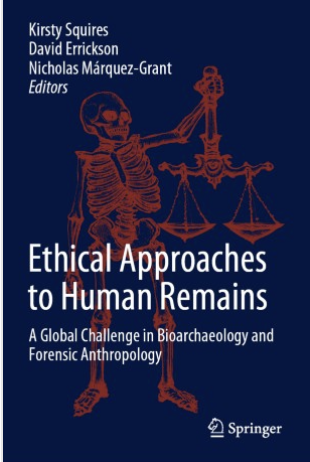
Edited by Kirsty Squires, David Errickson and Nicholas Márquez-Grant, 2019, Springer, 649 pp, ISBN 978-3-030-32925-9
Keywords: Ethics in Biological and Physical Anthropology, Ethics in Forensic Anthropology, Treatment of Human Remains, Repatriation of Human Remains, Multidisciplinary
Amongst sciences that study the human body, anthropology has a critical and dark history surrounding the treatment of human remains. For instance, it is widely known that pioneers in the discipline collected human remains under conditions that today are considered dubious and unethical (Clegg 2020). More recently, anthropologists have adopted a more ethical approach by questioning the origin of human remains and the context of their acquisition (Fluehr-Lobban 2008; Klenk 2010). Along the same line, universities, museums, organizations, and associations have developed guides and codes of ethics to regulate, standardize and implement ethical practices within the discipline (AAPA 2003; BABAO 2010a, 2010b; WAC 2018). Ethical Approaches to Human Remains. A Global Challenge in Bioarchaeology and Forensic Anthropology,is a consolidated volume that brings together 30 chapters written by anthropologists and scholars from various disciplines to contribute to current issues, challenges and topics associated with human remains and ethics.
The volume is structured in three sections, excluding the introduction and the conclusion. The introduction addresses the lack of literature gathering current issues about human remains under one manuscript. The authors disclose that the objectives of the volume are to raise awareness towards the treatment of human remains, put forward a worldview of challenges and offer recommendations and considerations for their future implementations. The first section of the book, Ethical issues surrounding human remains, explores ethical concerns related to human remains from a philosophical and social angle. Authors discuss consent, dignity of the dead and human right after death, representativeness of human remains in research, unethical past practices, and ethical transformations in the profession of human anatomy, and issues raised by the online human remains trade. The second section, Ethical dilemmas in bioarchaeology and forensic anthropology is written from the perspective of scholars based in the United Kingdom. Chapters in this section explore ethical dilemmas encountered in bioarchaeology and forensic anthropology, such as the excavation, analysis, curation, and display of human remains along with challenges caused by the rise of social media, use of digital data, and creation of human taphonomy facilities. The third section, Global perspectives and case studies, presents case studies where practitioners have faced ethical dilemmas during recovery, identification, and repatriation of human remains in various regions of the world. These case studies outline good practices while also outlining challenges that must be considered in the process of developing ethical practices in bioarchaeology and forensic anthropology in different parts of the world. Concluding remarks summarize main topics and current issues, such as collaborations with descendants and local communities, the rise of destructive or invasive sampling, social media, and 3D data. The authors conclude with recommendations for best practices drawn from the contributions of the specialists in this volume.
The highlight of this book is that each chapter offers a unique perspective on a specific subject about human remains. The myriad authors’ specializations enables this book to be accessible for a large audience. Hence, by discussing ethical dilemmas, rising issues and challenges encountered in various countries, this manuscript contributes to the current discussion about ethics and human remains emerging in multiple disciplines. In addition, it addresses considerations related to consent, right of the dead, respect, descendant communities, repatriation, and Indigenous people’s voices. One can say that even if a reader is not specifically interested in human remains, the content of this book makes it possible to learn about other aspects of a particular case, as it is viewed under different lenses (e.g., human remains treatment during the Spanish Civil War and World Wars). From academics to the public, there is something for everyone. Furthermore, multiple chapters propose recommendations, guides, and codes to consider while working with human remains. These suggestions can be helpful to implement guidelines and codes of ethics in institutions with collections of human remains that are not regulated yet by an ethical framework. Although the second section mainly focuses on practices in the United Kingdom, it is significant to note that cases invoked can help guide, advise, and inspire researchers and specialists facing similar situations. Moreover, the volume can be beneficial in training students to adopt good practices while working with human remains.
Another fundamental aspect of this book is the prominence of collaboration with communities, descendants, and Indigenous people. For a long time, the relationship between scholars and communities has been neglected. Nowadays, practices demonstrate a paradigm shift concerning the involvement of stakeholders, where research would be considered unethical without the permission and consent of descendant communities. This good practice is one of the founding principles of research ethics. Aside from the emphasis on collaboration, the volume includes chapters written by scholars that are part of local communities. For instance, Chapter 19, Ethical issues of Bioarchaeology in New Zealand-Aotearoa: Relationships, Research, and Repatriation, provides a review from both a Māori and bioarchaeological perspective on repatriation matters related to kōiwi tangata Māori (ancestral remains). One of the authors of this chapter (Amber Aranui) is a Māori repatriation researcher, and her perception on the issues surrounding the use of Māori human skeletal remains offers a profound analysis for readers. This volume demonstrates positive outcomes of forming partnerships and engaging in collaboration with communities. Thus, in a manuscript discussing ethics, it is evidently more ethical to include diverse voices, such as local communities, descendants, and Indigenous people, to acquire distinct perspectives on topics that, for a long time, have been extensively and unilaterally analyzed by foreign scholars.
The volume touches on worldwide issues and challenges, and naturally cannot exhaustively review all queries about ethics and human remains. However, in a decolonization setting, it would have been relevant to further explore the topic of repatriation. For instance, institutions such as museums and universities with collections of human remains originating from other countries should question the origin of these remains, and be more aware of the subtle, yet highly significant difference between “repatriation” and “restitution” (Bienkowski 2013). Interestingly, only Chapter 20, Ethical Considerations of Human Remains Based Research in Argentina briefly mentions “restitution” but without distinguishing it from “repatriation.” Moreover, concerns surrounding access to human remains (e.g., ownership and stewardship) and the vicious race between researchers to access rare ancient human remains to perform destructive analysis (to obtain ancient DNA) have not been amply explored and require an extensive discussion beyond this book.
Undoubtedly, present-day practices in anthropology are widely different compared to the early days of the discipline. For instance, research ethics committees of most universities and research institutions request ethical permission for research when working with human remains. Hence, researchers must anticipate ethical questions even before starting a research project. Nonetheless, practices are not flawless, and much remains to be done. In this regard, Ethical Approaches to Human Remains contributes to the current debate about the treatment of human remains around the world. The volume presents a current perspective on ethical challenges faced by specialists and practitioners, along with emerging matters rarely addressed in the literature, in particular digital ethics, the use of social media, the views of Indigenous communities and collaborative work. The various topic raised, and the recommendations provided by the authors are expected to be significant in improving practices. Ultimately, this manuscript serves as a reminder for anthropologists and other practitioners to not neglect their ethical responsibility towards human remains and descendant communities.
Works Cited:
American Association of Biological Anthropologists [AABA]. Code of Ethics of the American Association of Physical Anthropologists. 2003. http://physanth.org/about/committees/ethics/aapa-code-ethics-and-other-ethics-resources/. Accessed 2 March 2022.
Bienkowski, Piotr. “A critique of museum restitution and repatriation practices.” The international handbooks of museum studies (2013): 431-453.
British Association of Biological Anthropology and Osteoarchaeology [BABAO]. Code of Ethics. 2010a. http://babao.org.uk/assets/Uploads/code-of-ethics.pdf. Accessed 2 March 2022.
British Association of Biological Anthropology and Osteoarchaeology [BABAO]. Code of Practice. 2010b. http://www.babao.org.uk/assets/Uploads/code-of-practice.pdf. Accessed 2 March 2022.
Clegg, Margaret. Human Remains: Curation, Reburial and Repatriation. Cambridge University Press, 2020.
Fluehr-Lobban, Carolyn. “Collaborative anthropology as twenty-first-century ethical anthropology.” Collaborative anthropologies 1, no. 1 (2008): 175-182. doi:10.1353/cla.0.0000.
Klenk, Michael. “Moral philosophy and the ‘ethical turn’in anthropology.” Zeitschrift für Ethik und Moralphilosophie 2, no. 2 (2019): 331-353.
World Archaeology Congress [WAC]. Code of Ethics. 2018. http://worldarch.org/code-of-ethics/
Yassmine Ghalem is a PhD student in the Department of Anthropology at Université de Montréal specializing in biological anthropology.
© 2022 Yassmine Ghalem

