
Keywords: Cuba, socialism, heritage, museums, narratives
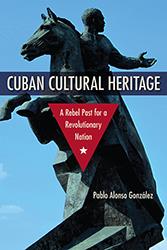
In the much-anticipated Cuban Cultural Heritage: A Rebel Past for a Revolutionary Nation, author Pablo Alonso González (2018) combines material culture, cultural heritage, history, and comparative politics in an appealing and sophisticated manner. The ambitious and detailed study examines the development of heritage form and content from 1902 to 2014, analyzing how particular processes and ideologies shaped architecture, monuments, public spaces, museums, national narratives, and the performance of national identity.
The work investigates how Cuban governments, stakeholders, and engaged social actors attempted to harness the power of heritage in post-independence Cuba, and the use of heritage as a vehicle for symbolic and material meaning production. One of the main arguments is that Cuban cultural heritage represents a discourse about the present – through the resignification and use of events of the past as “raw material” for meaning production. An important contribution is the author’s use of “virgin” source material that expands the theoretical and analytical scope of the book. Scholars conducting research in Cuba will appreciate the effort that the breadth of empirical data and archival documentation represents.
The author identifies critical ideological debates in each period, analyzing how Cuban authorities attempted to refine revolutionary principles and harmonize them with the values of influential foreign allies and international collaborators. Two examples from the Revolutionary era are Cuba’s “crypto-colonial” relationship with the USSR and longstanding collaborations with UNESCO. Valuable discussions address the role of Cuban coloniality in the symbolic order of heritagization, and the evolution of Cuban socialism from a comparative perspective.
Republican Heritage
As the author illustrates, a quest for modernization, social fragmentation, and political turbulence characterized Cuba’s Republican period (1902-1959).[i] Cuban governments were not the primary heritage benefactors, and the lack of clear political and ideological strategies hindered a cohesive ideology, state-sponsorship, and effective use of heritage.[ii] Several discussions highlight the contradictions and complexity of this period – and Cuban heritage in general. One example is the ambiguous role of Fernando Ortiz as a public intellectual and representative of a “pan-Hispanic community” (43). His interest in “the past” and preservation was part of a counterbalance to the “modernizing thrust” of the Republican era.[iii] “Cuban intellectuals and especially historians started to function as self-conscious builders of national identity, looking for the national roots in the past,” notes Alonso González (2018:42). Ortiz and new institutions, such as the Society of Cuban Folklore and the Academy of History, contributed to the creation of a new “epic national narrative” based on the War of Independence (43). To expand this trajectory, one could explore how Ortiz and fellow criminologists furthered the era’s “modernizing thrust” through the study of Afro-Cuban religions as criminality and promotion of legislation and practices created to civilize and “de-Africanize” society.[iv]
Revolutionary Heritage
The analysis of heritage after 1959 describes three periods of Cuban socialism and the use of heritage to achieve three objectives: the creation of new socialist symbols, promotion of master-narratives about the nation, and universal public education about Cuban socialism and nationalism.
The examination of the early years of the revolution (1959-1973) analyzes how “the transformation of the old symbolic order to suit the new political needs triggered a process of cultural violence” (74). [v] The government assigned positive and negative values to the colonial and republican periods, attempting to redefine significant aspects and realities of life before and after the Revolution. The reader discovers internal debates and the emergence of a “new early master-narrative for passion” promoting the foundational myth of the birth of the Cuban nation (99).
The analysis of the “institutionalization of the Cuban heritage field” (1973-1990) considers the proliferation of heritage laws and museums, and the implementation of new symbolic orders and narrative practices. The focus is how the growing state heritage infrastructure, the power of the Cuban Communist Party, and new legislation, such as Law 1 of Cultural Heritage Protection (1977) and the Municipal Museums Law (1976), facilitated a shift from symbolism to iconicity. Another trajectory explores the influence of Fernando Ortiz’s notion of “transculturation,” and the evolving symbolic order, particularly the merging of “folklorization” and an imposed “cultural localism” in municipal museums.
Examining the “reification of ideology as heritage and the return of the nation between 1990 and 2014,” the author suggests that the regime “enacted a sea change in its self-representation” through the inclusion and cooption of symbols of non-European traditions and history, such as slavery and Afro-Cuban religions (201). An unresolved question is whether the Cuban authorities inherited its epistemological biases from soviet museography. The lacking epistemological reflexivity could have Cuban origins, for instance equating “culture with alterity and specifically with the oppressed,” as part of an ongoing politics of assimilation in Cuba (200).[vi] Nevertheless, as the author notes, “despite transculturation talk, actual transculturation is neglected and processes of social dynamics are concealed” (2018:201).
Cuban Cultural Heritage is a unique contribution to the Cuban studies and heritage fields. The author addresses many intended and unintended consequences of cultural heritage, for the Cuban state and citizens. The book offers much to discover, debate, and enjoy.
Works Cited:
Alonso González, Pablo. 2016. “Monumental Art and Hidden Transcripts of Resistance in Revolutionary Cuba, 1970–1990.” Journal of Latin American Cultural Studies 25(2): 271-296.
Alonso González, Pablo. 2018. Cuban Cultural Heritage. A Rebel Past for a Revolutionary nation. Gainesville, University Press of Florida.
Bronfman, Alejandra. 2004. Measures of Equality: Social Science, Citizenship, and Race in Cuba, 1902–1940 (Envisioning Cuba). Chapel Hill: The University of North Carolina Press.
Hamlish, Tamara. 1995. “Preserving the Palace: Museums and the Making of Nationalism(s) in Twentieth-Century China.” Museum Anthropology 19(2): 20.
Hamlish, Tamara. 2000. “Global Culture, Modern Heritage: Re-membering the Chinese Imperial Collection”. In Museums and Memory, edited by Susan A. Crane, 137-158. Stanford, CA: Stanford University Press.
Kearney, Michael. 1996. Reconceptualizing the Peasantry: Anthropology in Global Perspective. Boulder, Colo, Westview Press.
Ortiz, Fernando. 1973. [1906] Hampa Afro-cubano: Los Negros Brujos. Apuntes para un Estudio de Etnología Criminal. Miami: Ediciones Universales.
Palmié, Stephan. 2002. Wizards and Scientists: Explorations in Afro-Cuban Modernity and Tradition. Durham and London: Duke University Press.
Sawyer, Mark Q. 2006. Racial Politics in Post-revolutionary Cuba. Cambridge: Cambridge University Press.
Scott, James C. 1990. Weapons of the Weak: Everyday Forms of Peasant Resistance. New Haven and London: Yale University Press.
Tisdel Flikke, Michelle A. 2006. “Cuban Museums and Afro-Cuban Heritage: Fragments and Transitions in Daily Life.” Unpublished Ph.D. thesis, Department of Anthropology, Harvard University.
Tisdel, Michelle A. 2008. “Three Interpretations of Materiality and Society: Afro-Cuban Heritage and the Cuban Slave Route Museum.” In Six Essays on the Materiality of Society and Culture, edited by Håkon Glørstad and Lotte Hedaeger, 87-125. Staviksvägen: Bricoleur Press.
Tisdel, Michelle A. 2018. “From Underworld to Museum Showcase Afro-Cuban Religions, Heritage Production and Cuban Cultural Policy” In Cultural Contestation: Heritage, Identity and the Role of Government, edited by Jeroen Rodenberg and Pieter Wagenaar, 105-137. Cham, Switzerland: Palgrave Macmillan.
Watson, Rubie S. 1994. Memory, History, and Opposition Under State Socialism. Santa Fe, N.M: School of American Research Press.
Watson, Rubie S. 1995. Palaces, Museums, and Squares: Chinese National Spaces. Museum Anthropology 19(2): 7-19.
© 2019 Michelle A. Tisdel

[i] The new Republic of Cuba inherited the deep-rooted social inequalities and racial hierarchy of colonialism and slavery, political fragmentation and volatility, and a precarious economy.
[ii] Republican heritage included ad-hoc initiatives and poorly conceived underfinanced state ventures. Civic organizations and wealthy individual collectors financed many projects. An exception to the lack of strategic heritage awareness, notes the author, was the Office of the Historian of the City of Havana (OHCH) under the direction of Emilio Roig de Leuchsenring and later Eusebio Leal Spengler.
[iii] The Cuban criminologist-turned ethnologist is renowned in Cuba for his study and celebration of Afro-Cuban religions. An exhibition at Casa de Africa in the OHCH described Ortiz as the “third discoverer of Cuba,” thus suggesting that he uncovered the value of Afro-Cuban cultural expressions (Tisdel Flikke 2006, Tisdel 2018).
[iv] The Cuban social sciences and scientific fields, such as criminal ethnology contributed to the reproduction of racial hierarchy. Ortiz was initially concerned with the assimilation and reform of Afro-Cuban practitioners, not the formation of new Afro-Cuban subjectivities (cf. Bronfman 2004; Palmié 2002, 242; Ortiz 1973 [1906]; Tisdel Flikke 2006, Tisdel 2018). Approaching mid-century, however, Ortiz turned his focus from criminology and criminal ethnology to folklore, ethnology, and related anthropological agendas (cf. Bronfman 2004, Palmié 2016).
[v]See also Hamlish 1995, 2000, Tisdel Flikke 2006, Tisdel 2008, 2018, and Watson 1994, 1995.
[vi] These new master-narratives can represent public transcripts (Scott 1990) and illustrate the cooption and “containment” (cf. Kearney 1996) of non-European subjectivities deemed incompatible with statist heritage. Moreover, the narrative can exemplify “inclusionary discrimination,” and thus highlight “limited gains” that Cuban socialism afforded these populations (Sawyer 2006, Tisdel 2018).

Michelle A. Tisdel works as a research librarian/associate professor at the National Library of Norway and holds a doctorate in Social Anthropology from Harvard University (2006). Tisdel held positions as Associate Professor of International Studies at Oslo University College and as curator at the Museum of Cultural History, University of Oslo. Her research interests include museums, heritage, cultural policy, narratives, autobiography, and discourses of belonging in Cuba and Norway. Tisdel has also served on the boards of directors of the Norwegian Museum of Cultural History and Museums in Akershus.
