
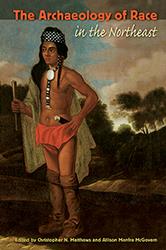
The authors in The Archaeology of Race in the Northeast, edited by Christopher N. Matthews and Allison Manfra McGovern, are part of the growing cohort of researchers within historical archaeology that reject a simple search for racial identity in material culture. Instead, they advocate for more critical studies addressing the processes of racialization and power structures inherent to the ideas of race. What makes this volume stand out are two main points. One is that it shifts focus away from the American South, where many, if not most, previous studies have been conducted to instead focus on an area of the country where issues of race and racism have often been obscured. The other key contribution this volume offers is that it refuses to use “race” as interchangeable with ethnicity. The contributors instead use their various studies to show how ideas of race are constructed, perpetuated, and interpreted by many different groups in the Northeast. They highlight how Native Americans, African Americans, and white European Americans intersected across many different spaces and how these relationships complicate our interpretation of the material past.
In their introduction, Matthews and McGovern describe how, unlike the popular histories of the American West or Southeast, the history of race in the Northeast is rarely discussed. If it is discussed, the narrative is often framed with Northerners as champions of freedom against a villainous South. The editors reject this idea and instead squarely align themselves with critical race scholars in other fields by stating that “the making of race in the Northeast, like the making of history there, has always involved the use of social power to structure the material worlds of people and to symbolize the communities people claim for themselves and/or assign to others” (p. 2). Therein lies one of the greatest strengths of this volume: it invites the reader to ask questions about our interpretations of archaeological sites rather than simply accept the authorial interpretation.
The first section of the book focuses on archaeological investigations of African and African American presences in the Northeast. This section comprises by far the largest portion of the book (nine chapters out of sixteen total), but Matthews and McGovern specifically address this imbalance as a reflection of current research agendas within the field. Nor would it be accurate to portray these sections as falling into neat racial categories as their titles might suggest. In Chapter 2, Cantwell and diZerega Wall focus on the African presence in New Amsterdam through the interpretation of the contents of a barrel feature found at the Broad Financial Center site in lower Manhattan. By using the contents of this midden to ask questions about who may have made it and why, rather than offer definitive interpretations, the authors seek to expand upon the history of New Amsterdam that often obscures the African presence in favor of a purely Dutch versus British narrative. In chapter 6, Yamin and Ziesing engage in a similar study, focusing on the questions brought about by the discovery of chamber pots bearing the American Eagle symbol. Like Cantwell and diZerega Wall, Yamin and Ziesing use these objects to guide their research questions and gain more insight into the former residents of their site, rather than offer definitive interpretations of the objects’ utility or meaning.
Chapters 3 and 4 demonstrate how the careful integration of historical documents with artifact analysis in the history of upstate New York can aid in our interpretation of spaces of racialization. Lindner and Johnson discuss how the artifacts and documents associated with the Primus Martin site near Hyde Park, New York demonstrate the African American residents’ resistance to racialized discourses by the surrounding Euro-American communities. The excavation also shows how the site may have been a hub for community-building in a region where other community spaces may have been largely absent. Delle and Fellows show how the Rose Hill site along Seneca Lake in upstate New York transitioned from a Virginia-style plantation with enslaved Africans into a capitalized farm with black tenant farmers, and finally began utilizing Irish immigrant tenant farmers paid at lower rates than the previous workers. The site, therefore, demonstrates the racialized nature of space itself, showing “the material legacy of the relationship between economic change, labor demographics, and racial hierarchy” (p. 95). In chapter 8, McQuinn contributes the idea of marronage, as defined by Sayers (2012, 143), to the interpretation of a site in Albany, New York to better understand its place as a refuge for those seeking freedom on the Underground Railroad. Barton and Orr continue this theme of negotiated space in their chapter on the practice of yard-sweeping at a site in southern New Jersey. Instead of seeing sweeping as a simple cultural continuation study, Barton and Orr use it to analyze the negotiation of space and community building further, advocating for research into what they call “practice theory of improvisation” where marginalized people create and maintain specific responses to their marginalization that are carefully weighed against other life factors.
In an especially well-crafted chapter, ““The Character of a Woman”: Womanhood and Race in Nineteenth-Century Nantucket”, Bulger uses the material culture associated with two women, Mary Boston Douglass and Eliza Boston Berry, of Nantucket, Massachusetts to discuss the intertwined nature of race, gender, embodiment, and performativity experienced by middle-class black women in the nineteenth century. This chapter emphasizes the archaeology of domestic space as showing how these women balanced middle-class ideals of respectability of their time with personal priorities to themselves and to their families. Chapters 7 and 9, by Kruczek-Aaron and Geismar respectively, discuss archaeological sites whose interpretation is enriched by the involvement of descendent communities in the excavation and management of the sites. Kruczek-Aaron emphasizes commemoration and the archaeologist’s complicated role as site steward in the Adirondack’s Timbucto site, while Geismar highlights the importance of the preservation of the Hunterfly Road houses which now comprise much of the Weeksville Heritage Center in Brooklyn.
The second section of the book, “Native American Historical Archaeologies”, is comprised of only two chapters but is especially theoretically-rich. In the introduction to the book, Matthews and McGovern push for the idea that studies based on race cannot simply be thought of as a recoded study of culture and/or ethnicity. This is because racial analyses are explicit in the idea that people have never been “living in distinct and isolated groups but must be seen as having lived in complex and conflicted communities that were defined by competition for resources and an unequal distribution of power” (p. 5). McGovern echoes this in chapter 11 by situating the Montaukett’s resistance to detribalization in nineteenth-century East Hampton, New York within the framework of a larger pattern of racialization and displacement experienced by many people of color. With a similar dialectical frame, Handsman discusses how the Mashpee and Narragansett communities dealt with those they deemed as “coloured foreigners” (i.e. other Native groups, African Americans, and other people of color) and how this differed from the Mashantucket Pequot, who apparently never had such distinctions based on race. These two chapters are a particular highlight of this volume because they demonstrate that racialization is not the sole province of those of African descent, nor is it a process that can be described monolithically even within so-called racial groups. Instead, both chapters show how race is dialectical and must constantly be negotiated by those groups in conversation with one another.
The final section addresses Archaeologies of Whiteness in the Northeast. It is perhaps framed best by Gorsline’s chapter, “An Archaeology of Accountability: Recovering and Interrogating the “Invisible” Race”. Gorsline addresses the reservations many may have of critical whiteness studies’ intrusion into archaeology, namely that in attempting to address white identity formation in the archaeological past, researchers may simply be re-centering white narratives at the expense of the stories of people of color. As a manner of redress, Gorsline proposes an “archaeology of accountability”, which was inspired by Bernbeck and Pollack’s “archaeology of perpetrators” (2007). Gorsline’s proposal specifically advocates that this type of archaeological research should expose how exploitation and oppression enacted by whites was key to white identity formation. However, the archaeology of accountability must explicitly connect past and present manifestations of white privilege to prevent an uncritical celebration of white history. The other two authors in this section, Matthews and Lewis, seem to follow this proposal with their own studies. Matthews draws upon the idea of the symbologies of freedom kept within the home as key to cementing an aggregate white identity in the Northeast. Material culture of Euro-American and European immigrant sites are therefore not free of race because the very symbology encoded within this material is built upon racial and racist structures. Lewis presents a more longitudinal study, showing how the memorialization of a violent event in the history of Deerfield, Massachusetts must continue to be reexamined if we are to uncover “the cult of whiteness” (Paynter 2001) inherent in our histories and archaeologies.
The volume ends with a reflection by Orser. In it, Orser presents three topics brought by the authors deemed worthy of further investigation: the mutability and stubbornness of racialization, the power of research to make visible such invisible processes, and the issue of scale in archaeology. The Archaeology of Race in the Northeast is praise-worthy for its efforts in all three of these arenas. The editors and authors have made a concentrated effort to show that processes of racialization affect every group within the history of the United States. They also show how archaeological analysis can help to shine light on how spatial and temporal peculiarities enact change on these processes of racialization. The authors contained in this volume are clearly part of a cohort of archaeologists eager to show what archaeology can offer to larger social science investigations of race in the United States. Following the examples outlined in this volume, future researchers will no doubt build upon these studies and hopefully work to finally break down, as Orser puts it, “the tyranny of racialization’s silence and invisibility” (p. 324).
Works Cited:
Bernbeck, Reinhard, and Susan Pollock. “‘Grabe, Wo Du Stehst!’ An Archaeology of Perpetrators.” In Archaeology and Capitalism: From Ethics to Politics, edited by Yannis Hamilakis and Philip Duke, 217–34. Walnut Creek, CA: Left Coast Press, 2007.
Paynter, Robert. “The Cult of Whiteness in Western New England.” In Race and the Archaeology of Identity, edited by Charles E. Orser Jr., 125–42. Salt Lake City: University of Utah Press, 2001.
Sayers, Daniel O. “Marronage Perspective for Historical Archaeology in the United States.” Historical Archaeology 46, no. 4 (2012): 135–61.


Adam Netzer Zimmer is a doctoral student in anthropology at the University of Massachusetts Amherst where he holds a Graduate Research Fellowship through the National Science Foundation and the Leifur Eiríksson Foundation Fellowship. He currently lives in Reykjavík, Iceland where he is researching the processes of cadaver recruitment and the skeletal collections left over after anatomical research in both the U.S. and Iceland.
