
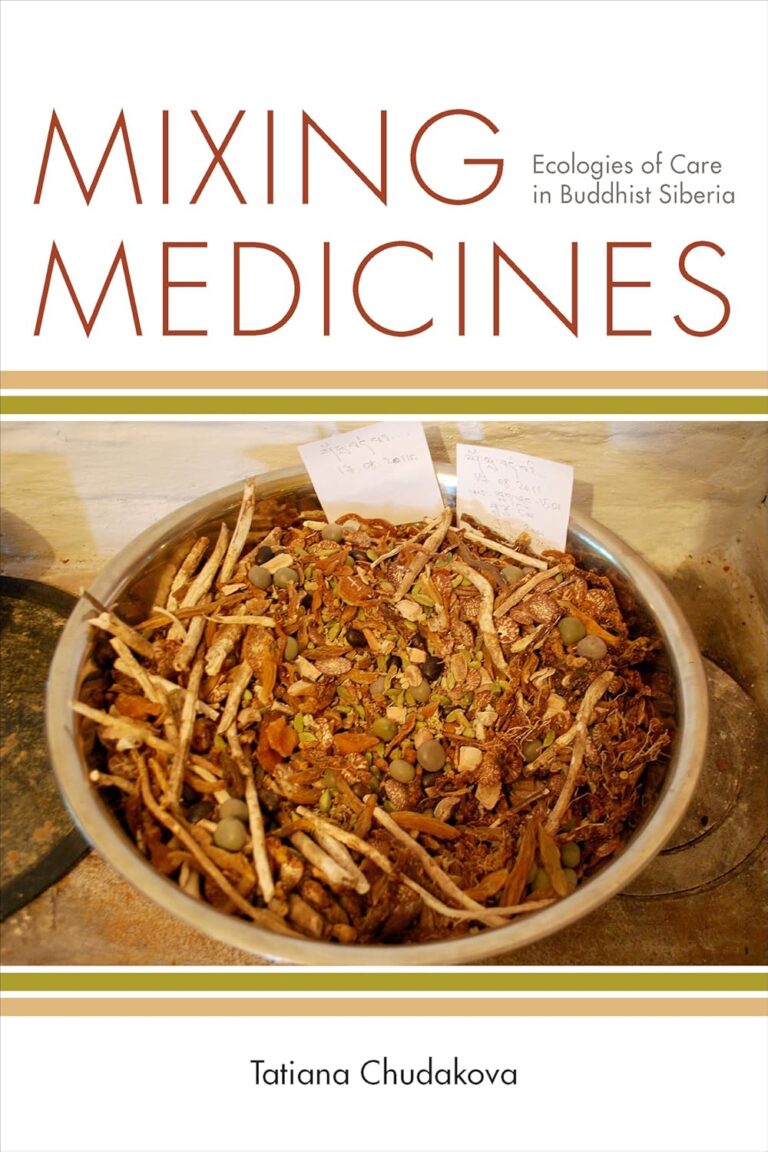
TATIANA CHUDAKOVA, 2021, Mixing Medicines: Ecologies of Care in Buddhist Siberia, New York: Fordham University Press, 333 pp. ISBN 978-0-8232-9431-2
KEYWORDS: Medicine, Russia, Buddhism, History of Science, Production of Knowledge
In today’s globalized world, it is common for individual patients and broader communities to seek health advice and intervention across multiple medical traditions, often combining biomedical approaches with others dubbed “traditional,” “complementary,” or “alternative.” In Tatiana Chudakova’s Mixing Medicines: Ecologies of Care in Buddhist Siberia the author deftly historicizes and analytically engages a captivating landscape of medical pluralism in Buryatia, one of three “ethnically Buddhist” regions in Russia. Central to the volume is a critique of the manner in which anthropologists often assumes that patients are driven away from biomedicine either by way of the failures of “official” medicine fostering desperation and medical omnivory, or via a pursuit of self liberation and economic subjecthood through the embrace of “unofficial” alternatives. Chudakova’s analysis suggests that these assumptions of a “centrifugal force” fail on two levels – first by assuming a biomedical center, and second because outward spinning inherently results in separation. Conversely, Tibetan medicine (Sowa Rigpa) and “modern” medicine are deeply intertwined in Siberia, “mixed” and cohabitating, even if they fail to achieve state-sponsored integration. And those entrusting Tibetan medical practitioners (emchi) are not just moving away from a biomedical center, but moving toward new projects of self-making in the post-socialist state.
In six dense chapters, Chudakova demonstrates the complex, politically ensnared, and continually evolving place of Tibetan medicine in ideological projects of nation-making, economic commercialization, and identity. Centered on encounters with practitioners, patients, and administrators at the “East-West Medicine Center” – a state institution that explicitly aims to offer rehabilitative medicine that combines “Eastern” and “Western” healing traditions – the research additionally includes observations from professional research conferences, a university research laboratory, and adjacent medical and religious spaces.
Chapter one makes clear the always-already hybrid and contested nature of Tibetan medicine in Siberia, where Buddhism arrived around the same time as the region’s incorporation into the Russian Empire. In subsequent centuries, competing epistemologies of religion and science emerged in the translations of central medical texts, and secular national consciousness pushed the Buddhist underpinnings of Tibetan medicine underground and aligned its therapeutics with biomedicine. The messiness of making and remaking of Tibetan medicine as medicine is illustrated in Chapter two through the case study of the “pulsometer” – a scientifically engineered machine meant to mimic and objectivize the use of pulse (or, pulses) for diagnostic purposes beyond the cardiovascular system. Rooted in the broader socialist project to discover the bioelectric thermal radiation underpinning extrasensory perception, the pulsometer centered on reverse engineering emchi perception through mechanization and imaging. But the continued reliance on emchi for not only calibration but interpretation of results, in the end, created a codependent “prosthetic” relationship.
Chapter three focuses on the prescribed manner in which peripheral regions like Buryatia are conceived in Moscow as the source of extractable natural resources, including the pharmacopeia of Tibetan medicine as an export for symptomatic, palliative care. This contradicts the emchi approach to treatment as both holistic and responsive to regionally-specific ailments. These contrasting approaches are illustrated in Chapter four, which centers on the East-West Medicine Center. Despite “Eastern” practitioners’ mission to address the “real” (root) causes of disease and to restore health by correcting subtle and individually experienced dysregulations and disadaptations to the environment, patients perceive their stay as a peripheral act of self-care rather than a medical necessity and they pick and choose treatments based on previous experiences and what they’ve heard from others is efficacious. Ironically, because the doctors at the East-West Medicine Center listen to their symptoms with a sympathetic ear, patients value the “personalized” care they receive. Meanwhile practitioners see themselves as incapacitated from offering the individualized care that is at the center of Tibetan medicine.
Chapter five dives deeper into the failures of integrating “official” and “unofficial” medicine in Russia. Legally, “unofficial” medicine is governed by a complex framework of regulations – “folk” practices (like homeopathy, medical massage, and reflexology) requiring a permit to practice (though no clear system exists for obtaining one), while healing techniques that are seen as religious are treated as small business ventures and subject to labor codes. In practice, Tibetan medicine can be legally practiced within the confines of biomedicine or as a religious business, this choice presenting a moral conundrum for emchi. The “official” medicine route requires reporting out in ways that are palatable to biomedicine, dividing singular practices into “Eastern” and “Western” components, diagnosing and responding to symptoms rather than getting to root causes, prescribing medicines that exacerbate imbalances, and treating each medical intervention as an island rather than considering their mutual impact on one another. On top of this, emchi in biomedical settings are expected to devote extensive time and emotional and social labor to sourcing ingredients and preparing remedies for patients. But, as a business, emchi are debasing the medical status of their enterprise.
Chapter six illustrates the arduous and highly contingent labor of making plants into therapeutic objects. The work is not simply extraction from a natural environment, but requires understanding of and engagement with relational histories, and monitoring for fluctuations in availability amidst constantly shifting human ecologies. This is followed by a conclusion in which the dissolution of the East-West Medicine Center (due to financial restructuring and perhaps lack of theoretical integration between its two directional currents) has left former practitioners more free to practice outside of biomedical structures in the private sector, but also subject to new forms of legal scrutiny. Chudakova stretches her theoretical muscle to discuss body politics, ontology, and precarity, ultimately arguing that economic and social upheaval are nothing new to the region of Buryatia and that it is through continued adaptation that both Tibetan medical practitioners and Tibetan medicine has and will continue to become locally rooted.
The depth of Chudakova’s historical contextualization of Russia and Tibetan medicine allows even someone unfamiliar with the region to follow the complex terrain covered in Mixing Medicines. And yet, the pages devoted to achieving this may have shortchanged the depth of its ethnographic emplacement and authorial reflexivity. Given the sophistication of the analysis and the extension of fieldwork over a period lasting more than ten years (2006-2017), it is clear that the author’s work was inspired through in-place experiences. But these manifest in the volume primarily through self-described ethnographic “events,” “episodes,” and “examples” – a description of the landscape when helping to collect plants, a snippet of conversation by office workers where each speaker is introduced through their personality quirks, or excerpts from conversational interviews with medical practitioners. Aside from a few self-depricating vignettes of interlocutors finding comic relief in her research agenda, the reader sees very little of the author in this volume and is rarely presented with a throughline connecting specific experiences and the emergence and iterative confirmation of ethnographic insight. Those snippets that do appear are instead used with some frequency to introduce (and justify?) what some readers may find to be peripheral historical minutiae. Still, few will find fault in the volume’s lucid writing, adept organization, breadth of secondary source work, and simultaneous insight into macrolevel subjects, like the history of science and the production of knowledge, and the microlevel details of accessing and laboring over Tibetan medicine in Siberia.
Arianna Huhn is a Professor in the Department of Anthropology at California State University San Bernardino and Director of the campus Anthropology Museum. A graduate of the George Washington University and Boston University, her training is in museum studies, medical anthropology, and African Studies. Fieldwork on food, health, and healing in Mozambique is published as Nourishing Life: Foodways and Humanity in an African Town (2020). Her museum work has focused on uplifting hidden stories through art and storytelling through exhibitions that include In|Dignity, Afróntalo, and INTO LIGHT California.
© 2025 Arianna Huhn
