
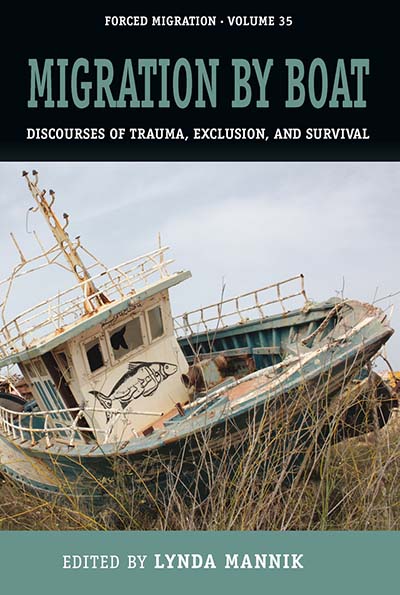
Images of drowned children, of African men and women in bright orange life vests, of newly arrived Syrian refugees on Greek islands—all these snapshots continue to shock and, in turn, numb European publics to the daily realities of the European migration crisis. Despite the sensationalist term ‘crisis’, as Lynda Mannik rightly points out in the introductory chapter of the multi-disciplinary collection of essays entitled Migration by Boat, human beings have migrated by boat for centuries. Moreover, it is only since “World War II that the legalities of such migrations have become increasingly contentious” (2018:1). Starting in 2015, European governments have taken ever more extraordinary measures to ensure that migrants do not land upon their shores. The latest measures, including the criminalization of NGOs that operate search and rescue missions in the Mediterranean and the tasking of nominal authorities in Libya with intercepting and detaining would-be migrants, have resulted in precipitous drops in the number of migrants entering the European Union. While this number declines, anti-migrant populists continue to gain ground in European elections. This seemingly paradoxical situation is not without historical precedent, as the authors in this edited volume make clear.
This collection of essays, adding to the scholarship of refugee and migration studies, travels through both time and space in its survey of boat migration. The authors chose to focus on boat migration because much is made in contemporary discourses of both the danger this form of migration poses for the migrants themselves and the threat that refugees who travel by boat are seen to present to societies in the Global North. Shifts in refugee policies throughout the 1980s and 90s first portrayed refugees from the Global South as uncontrollable masses threatening Western economic prosperity and security. These refugees and migrants are generally perceived to be threats to international order as they transgress consecrated notions of territory, demarcated and increasingly impassable borders, and racialized forms of national belonging. As migration policies in Global–North nations shift towards securitized borders, the attenuation of the right to settle, and the closure of available channels of authorized movement, migrants from the Global South find themselves undertaking dangerous maritime journeys. As the authors argue, while these journeys present clear challenges for those involved, they also create new forms of belonging, confound “terrestrial nationalism” (Nguyen, ch. 3), and sew complex webs of sociality along the way.
The book is organized with four themes in mind: public and private memorialization, artistic production, media and representation, and the phenomenological aspect of boat migration. The essays in this book are a corrective to negative media representations that mark this phenomenon; the authors also work to recover the voices of those who survived the journeys and those who did not. As such, this is a valuable collection of case studies examining boat migration in all its complexity. The geographic focus spans Australia, the Euro-African Mediterranean, and North America. In the first section titled Embedded Memories for Public Consumption, the authors engage with memorialization politics. Roseman’s piece traces the rise of a memory-activism movement centered around British child–labor migrants’ passage to Canada from the late 19th to the early 20th century. In particular, Roseman analyzes children’s literature produced in the 1990s that commemorates the repressed history of Canada’s use of child labor migrants. Tao’s piece examines “how migration by boat has been remembered and represented in three recent programs at the Australian National Maritime Museum” (p.49). The author focuses on the display “Waves of Migration,” which aims to historicize the different refugee groups that have arrived in Australia in its post-war history. The following essay on “Oceanic Spatiality and the Vietnamese Diaspora” best addresses the themes of the collection. The first ‘boat people’ to seize public consciousness were Vietnamese refugees fleeing the Vietnam War in the 1970s. As such, Nguyen’s piece touches upon memory, loss, trauma, and the constitution of new forms of sociality and belonging that boat migration engenders. The author does so through a critical engagement with Vietnamese diasporic literature, arguing, in effect, that the sea “[is] a space that facilitates and bares the traces of various human movements—one of them being asylum seekers” (p.70). This repositioning of the sea as the central site of human mobility and migration taking place at this historical juncture is the crux of this collection of essays. Never has migration been so dangerous in the post-war moment, a fact that the authors unveil as a consequence of the global migration management policies of wealthy states.
The second section titled “The artist and the illegal migrant” focuses on the politics of commemoration, specifically of artistic production. The three essays in this section all refer to border-externalization programs, such as the remote detention centers of the Euro-Mediterranean and Australia. The first, written by Horsti, focuses on artistic representations of Europe’s border externalization policies. She analyzes the Mimmo Paladino’s sculpture displayed on the Sicilian island of Lampedusa, entitled Porta d’Europa, and that of Kalliopi Lemo’s piece At Crossroads, which displays relics of migrant boats as part of an exhibition at the Brandenburg Gate in Berlin, named At Crossroads. While the authors argue that the violence of Europe’s border-externalization policies is kept out of view, these artistic works re-center the border both spatially and symbolically in western metropoles, confronting the cultural amnesia that surrounds migrant deaths at sea. Rutherford’s piece, a critical analysis of J.M. Coetzee’s The Childhood of Jesus, links Coetzee’s allegory to Australia’s treatment of migrants in its offshore processing centers and to a wider framework of how Australians understand the originating violence that brought Australia into existence. By using the concept of “holing,” “the propelling or projecting a subject into a negative space” (pp. 102), Rutherford argues that Australia’s policies around irregular maritime migration serves to “hole asylum seekers semantically, spatially, juridically, and discursively” (pp. 103). David Alvarez’s follow-up essay argues that the small boats used to traverse the Strait of Gibraltar “implicitly contest the priorities of current cross-Mediterranean mobility regimes” (pp. 117). Together the essays contest the politics of forgetting that border externalization schemes effect by keeping the violence of the border far from public view and deliberation.
The third section, much like the previous one, focuses on memorialization politics through discursive analysis of efforts to memorialize migrant deaths at sea. Salerno’s piece locates the commemorative efforts of the Katër I Radës, the pivotal shipwreck marking the beginning of Europe’s regime of death in the Mediterranean. Salerno argues that efforts to memorialize the wreck, which excluded the voices and testimonies of survivors, failed to mourn those who lost their lives adequately, as it only served to reify existing discourses of Italian hospitality. The memorial, which focused on the reaction of local Italians, ignored the need of survivors, their families, and friends to grieve for those who died. Instead, the memorial turned into a celebration of locals’ hospitality in the face of strangers. Olivieri’s piece examines the efforts of mothers of Tunisian migrants to hold public authorities accountable for the disappearances of their sons at sea. Their efforts work to re-politicize migrant death as a consequence of political decision making, which values Western security over the rights of refugees. In the third essay of the set, Mannik departs from the previous two approaches, which center on European migration, and engages in a discourse analysis of news reports about the arrival of Sikh refugees to Nova Scotia in 1987. It succeeds in tracing how media panic over the arrival of boat migrants shifts public opinion rightwards on the political spectrum. In the fourth essay, Hintjen emphasizes the role small islands play in the reporting on the European migration crisis. All four authors in this section agree that media reports on boat-migration do little to humanize boat migrants or to elucidate the political decision making that has made seeking refuge so dangerous.
The final section acts as a rejoinder to the politics of representation that the previous section unmasks. By focusing on the subjective experience of boat migration, the authors shift the emphasis to those who should matter most— the refugees themselves. The narratives of refugees who survived these maritime journeys frame this final section. Sue Hoffman examines the complicated relationships engendered by human smuggling through the example of Iraqi refugees and their journeys to Australia. Papa Saw et al.’s essay draws upon the experiences of Senegalese boat people migrating to Europe to chart the complex affective responses elicited by migrant trajectories—in both failed and successful attempts to reach Europe. Briskman and Demasi’s final piece looks towards the 2010 Janga boat crash off Christmas Island, in which 50 people died within sight of land.
The plurality of voices in this collection of essays serves as both a strength and a potential weakness. The collection does an excellent job tracing the political and legal transformations of migration regimes; however, while I recognize the difficulty and sensitivity of conducting ethnographic research with vulnerable groups like boat migrants, the collection would have been better served by the inclusion of more ethnographic insights. Moreover, while the two Canadian examples underscore the geographic breadth of boat migration, the reality remains that the European Union and Australia have taken to securitizing the seas just as other powers, like the United States, have increasingly deployed natural barriers, like the desert, as forms of border violence, a topic explored in excellent theoretical and empirical depth in Jason DeLeon’s The Land of Open Graves (2015). Canada has, largely, avoided these issues due to two factors: it’s lack of geographic proximity to the Global South and because of the Canada-United States Safe Third Country Agreement, which stipulates that refugees apply for asylum in the first country of entry. This agreement functions much like the Dublin regulations in the European Union, which shifts responsibility for migrant reception and rescue to its Southern partners. This is, however, only a minor critique; Migration by Boat is an exhaustive survey on maritime migration in an era of securitized borders. It is also an incredibly valuable compendium for students and scholars in migration studies, critical border and refugee studies, and for those who generally grapple with our contemporary moment.
Works Cited:
De León, J. 2015. The Land of Open Graves: Living and Dying on the Migrant Trail. Oakland, CA: University of California Press.


Fiori Berhane is a PhD candidate in socio-cultural anthropology at Brown University. She is currently finishing her fieldwork in Italy on Eritrean migrants' political polarization and memorializing practices within what is largely termed the ‘migration crisis’. Her work engages theories on forced migration and refugeeism and identity, memory and politics, with an emphasis on chronicity and notions of crisis. Her research has thus far been supported by the Fulbright IIE, the Wenner Gren foundation for Research in Anthropology, and the Mellon Demographic Fund at the Population Studies Training Center at Brown University.
