
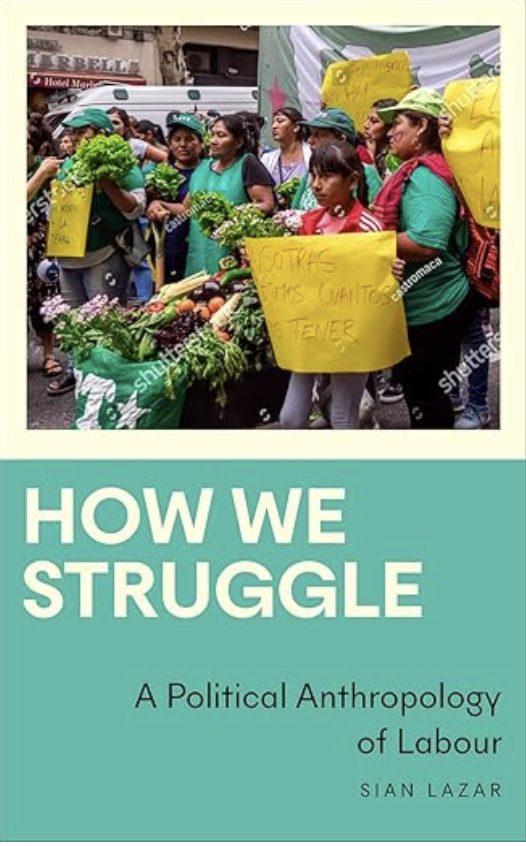
LAZAR, SIAN, 2023, How We Struggle: A Political Anthropology of Labour. London: Pluto Press, 392 pp., ISBN 978 0 7453 4754 7 EPUB
Keywords: Resistance, labor, ethnography, collective action, workplace, unions
Sian Lazar’s How We Struggle: A Political Anthropology of Labor comprises a soaring review of recent labor ethnologies across the globe that converge to insist upon a more nuanced and transformational understanding of worker resistance. While at times overwhelming in scope – her analysis includes a review of worker resistance in factories, sweatshops, farms, office buildings, call centers, delivery workers, and social activism writ large from India to Argentina to Eastern Europe and everywhere in between – How We Struggle is a vitally important contribution to a growing and evolving theoretical understanding of labor agency.
Lazar rightly points to the limitations and hegemony of the white, male, industrial, union organizer archetype in the common imaginary of what it means to resist oppression at work. Not only does work today rarely resemble the “standard employment relationship” that dominated conceptions of work in the mid-20th century (and, as she points out, was only ever accessible to a privileged minority), worker resistance has evolved as well. Indeed, as she asserts, “It is not only capital that is creative, but workers too.”[i] Through assembling these ethnographies and putting them in dialogue with one another, Lazar dissolves the binary between submissive victim and active industrial proletariat resistance. In this way she recognizes and thereby honors the myriad other forms of resistance that exist, while at the same time expanding our collective capacity to imagine other ways of making a (life worth) living. In contrast with protest, which she states “is spectacular and therefore amenable to research and comment; indeed, that is usually the point. […] Workers do not always resist, and often their agency can be found in ways that they respond to their conditions of work that are not exactly oppositional, either overtly or covertly.”[ii] Embracing a “capacious notion of agency”[1] that welcomes the covert and incremental alongside the spectacular, therefore, allows for an evolving understanding of resistance alongside an evolving understanding of late capitalist oppression in the post-Fordist, informal economy that dominates worker relations worldwide.
Of Lazar’s most important contributions in this book is her insistence on a feminist and pluralized approach to labor agency. In her review of working conditions in the garment industry, she notes that agency more often takes the form of individual physical and medical ailments than collective resistance, as the grueling demands of the workplace engender health complications that lead to workers disrupting the flow of production through calling out sick or moving at a slower pace. Rather than dismissing these more individual, non-coordinated efforts as “not resistance,” she pointedly asks: “But is this a problem for the workers or for our analytical categories? Do our gendered assumptions about labour agency mean that we expect a kind of class consciousness and organised resistance that could not come out of the modes of production specific to these industries?”[2] In How We Struggle she is offering, in essence, a new analytical category, one that recognizes the effects of smaller scale and less direct mechanisms of resistance. Lazar highlights the influence of global migration patterns on labor conditions and the construction of care chains across national borders as workers share childrearing responsibilities across generations and continents; acknowledges the central role of affection and relationality in the willingness or ability of a worker to withhold their labor in education or homecare; and identifies the role of ritual and joy in sustaining productive work and social reproductive work. She calls attention to the skilled and strenuous labor of navigating bureaucratic hurdles and adjusting behavioral patterns required to receive welfare support and emphasizes the intersections of workplace activism with global movements such as Black Lives Matter as workers themselves recognize and react to the omnipresence of “the danger of death and of life made unliveable [sic]”[iii] in 21st century society – dangers that include but are not limited to the workplace. Her most compelling examples in the book stem from her own first-hand experience, perhaps not surprisingly in a field that values close encounters. These particular narratives stem from her own position as an academic, for whom “overidentification” with work forms a corollary to the alienation of the industrial worker,[iv] as well as from her own field research on kinship networks in labor unions in Argentina.
The most troubling moment for me in reading the book, however, is a mere aside for Lazar. In her summation of Kathleen Millar’s ethnography of trash collectors in Rio de Janeiro,[v] Lazar briefly mentions that the local government restricted access to these dumps after Millar’s fieldwork, though she does not address the ethical quandaries and complexities that this fact surfaces. Not having read Millar’s own account of this myself, I am left wondering what happened to these workers after she concluded her field research, how they adjusted to this restriction in access to their main livelihoods, and what may have happened to the relationship between Millar and her research participants as a result. Throughout How We Struggle, Lazar asserts the importance of ethnography in offering a tool to shift our analysis of workplace resistance, arguing that it is ethnography that provides the detailed and intimate perspective on workers’ lives to better recognize and theorize worker resistance and agency. Yet she does not address the consequences of this anthropological labor itself: Who benefits from this research? What are the after-effects – good and bad – of anthropological research on the researcher’s subjects? The extractive nature of anthropology has long been contested; given Lazar’s own focus on worker agency, I am surprised at this omission. Instead, looking at the question through her offered analytical lens, I am left wondering about what forms worker oppression and activism within the realm of the labor of ethnography might take, and how that is transforming anthropology as well.
References
Millar, Kathleen. Reclaiming the Discarded: Life and Labor on Rio’s Garbage Dump. Durham, NC: Duke University Press, 2018.
Lazar, Sian. How We Struggle: A Political Anthropology of Labour. London: Pluto Press, 2023.
Amanda Tobin Ripley is a doctoral candidate in Arts Administration, Education, and Policy at Ohio State University, where she specializes in Museum Education and Administration. Her research focuses on the intersections of the art museum labor movement and grassroots efforts toward social change. Amanda holds an M.Ed. from the Harvard Graduate School of Education in Arts in Education and a B.A. from Oberlin College in Art History and East Asian Studies. She most recently served as the Associate Director of Education at MASS MoCA and was a founding member of the MASS MoCA Union (UAW Local 2110).
© 2024 Amanda Tobin Ripley