
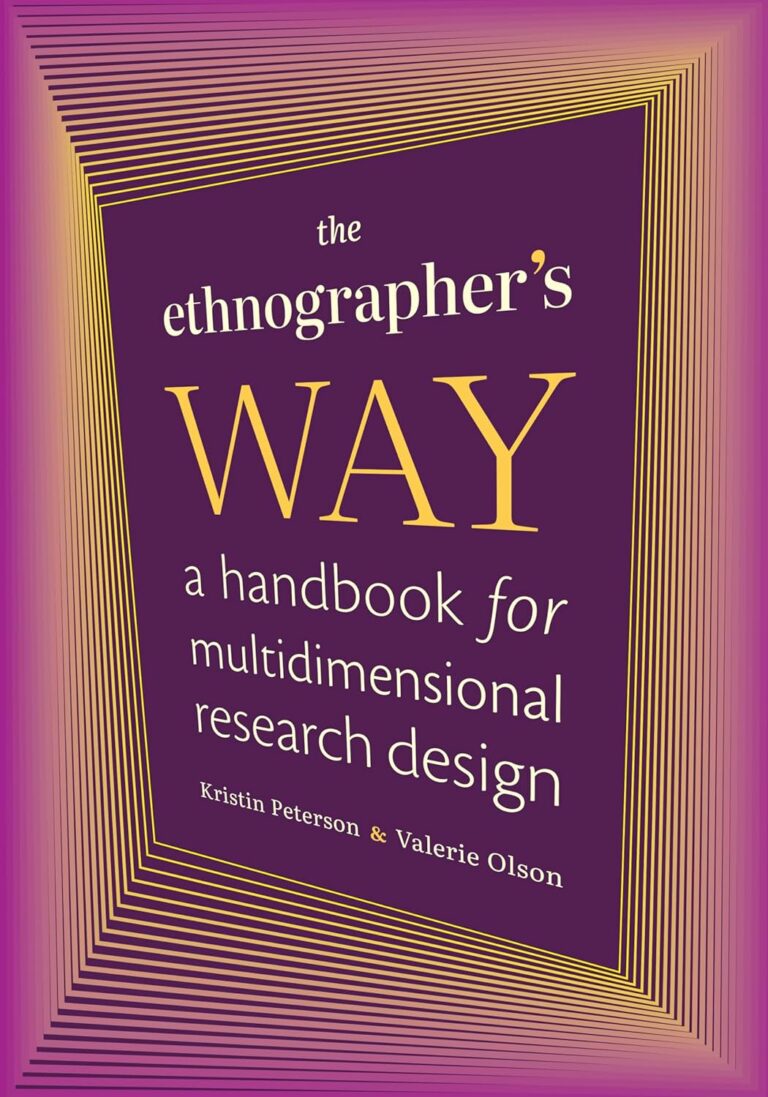
KRISTIN PETERSON and VALERIE OLSON, 2024, The Ethnographer’s Way: A Handbook for Multidimensional Research Design, Durham and London: Duke University Press, 338 pp., ISBN 978-1-4780-2590-0
Keywords: Ethnography, research design, research methodology, qualitative methods, multidimensional design.
How to Plan an Ethnography Without Suffering Unnecessarily in the Process could be another fitting title for the wonderful book written by Kristin Peterson and Valerie Olson. It serves as a comprehensive and approachable guide for those embarking on the exciting yet challenging task of designing ethnographic research.
Throughout an introductory section and ten modules, the authors provide readers with insights developed from their extensive experience as researchers and educators to plan and design ethnographic projects.
Unlike other handbooks on research methodology, Peterson and Olson pay attention to details that are commonly considered peripheral to the research design process. From the importance of maintaining a comfortable workspace to the value of engaging in dialogue with others to enrich our work, the authors address these aspects with sensitivity and seriousness.
They also acknowledge that the process of planning research is not linear and involves ups and downs that frequently challenge our convictions and may even discourage us from continuing. In this regard, the book emphasizes that it is an iterative process in which we continuously revisit various concerns. Therefore, one principle the authors suggest is to value the process before seeking quick results.
This holistic perspective underscores the importance of remembering that behind any project is always a person with intertwined concerns, uncertainties, and dreams. Thus, The Ethnographer’s Way: A Handbook for Multidimensional Research Design presents itself as a deeply human text, attuned to the factors that affect the labyrinthine path toward a coherent and motivating research approach.
The authors focus on the initial stages of design to develop the theoretical and empirical notions that researchers have from the start, and to turn them into a coherent framework with clear questions that can be addressed using data collection techniques. To achieve this, they propose the concept of multidimensional design, which broadly aims to integrate different concepts and intentions into a consistent research framework. In this context, “dimension” refers not only to the characteristics or values that a theoretical category might encompass— as commonly conceived in qualitative research— but is also considered from a broad perspective, including any term that constitutes the project, whether empirical or theoretical, such as objects, places, and contexts.
Therefore, Peterson and Olson encourage fostering intuition, curiosity, and imagination to find connections between elements and ideas that, based on our experiences, seem to have at least a vague relationship. With this goal in mind, the book includes eight activity modules that are ideally carried out in discussion and exchange communities, though it is also applicable to researchers who need to conduct their process in solitude.
Module 1 focuses on writing the research imaginary, a narrative exercise about the project’s context, potentials, and objectives. Before confining our ideas with concepts and norms, the authors guide us to freely express the sketches and intuitions from which the desire to create a research project arises, thereby identifying central concepts. By the end of this module, the reader will have constructed a grid that organizes and clarifies the main elements.
Module 2 is dedicated to identifying which other works we can engage with or, in other words, finding the literature that will frame the research. In addition to exercises that help locate key discussion points, the authors remind us that engaging with others—whether orally or textually—requires respect and a willingness to learn.
Module 3, titled Map Concepts, aims to explore the possibilities for connecting the elements identified in previous modules. It involves seeking ways to represent concepts on a map to illustrate their interrelationships.
In Module 4, the central objective of the book begins to take shape: designing a multidimensional project. At this stage, the reader will identify at least one combination of concepts that will determine the contribution of the work to existing literature and will begin to see clearly how empirical and theoretical notions intertwine.
Module 5, titled Describe Your Research, focuses on developing a concise and clear description of the project, including the central concepts and the potential of the work.
Module 6 is directed at crafting a statement that evokes the multidimensionality of the project and the theoretical assumptions that justify the relationship between its elements, addressing the notion of structural tensegrity.
Module 7 aims for the reader to condense all conceptual work into a general research question. This general question will lead to specific questions that will define how to obtain empirical information, covered in the next module.
Module 8 is dedicated to data collection, focusing on defining the type of information needed to answer the research question and how to obtain it.
Module 9, titled The Interacting Zone, seeks to transition the reader from thinking about categories and data to reflecting on the concrete actions and forms of involvement in fieldwork. Hence the term “interacting”, as it involves framing the research work within a network of relationships and circumstances that will influence the researcher and the techniques used.
Finally, Module 10 presents tools to refine everything covered in the previous modules and to prepare the necessary materials for ethics committee applications, grant proposals, or multidimensionality during field research.
In summary, one of the book’s great strengths is its insight into making connections between intuitive ideas, theoretical concepts, and empirical aspects in a rigorous manner to produce innovative projects with significant contributions. As a result, the creative process is stripped of its mystique and becomes an endeavor accessible to anyone committed to diligent work.
Another aspect to be appreciated is the engaging and didactic way in which the activities are presented. Unlike the convoluted language that characterizes many academic works, the text is accessible to students and researchers at all levels by addressing highly complex issues in an admirably simple manner. This is undoubtedly a reflection of the authors’ experience in sharing their knowledge and guiding others through the process of conducting research.
Thus, The Ethnographer’s Way is not just a manual but a compass for those seeking to transform ideas into robust and multidimensional research. Peterson and Olson provide an innovative approach that breaks with traditional practices and opens new avenues for research design. By addressing aspects that other manuals overlook and fostering collaboration, this book stands as an indispensable guide for researchers at all levels. With a blend of theory and practice, The Ethnographer’s Way not only instructs but also inspires, challenging academics to push their projects beyond conventional limits and explore the true potential of ethnographic research.
María Gabriela Durán-Valis holds a Master’s degree in Social Anthropology from the Center for Research and Higher Studies in Social Anthropology (CIESAS), Mexico. Her research focuses on analyzing the trajectories and outcomes of the legal mobilization of groups advocating for land rights against extractive and infrastructure projects in Mexico. She currently works as a research assistant at the Universidad Iberoamericana.
© 2024 María Gabriela Durán-Valis
