
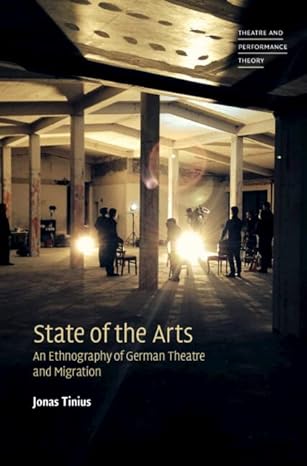
JONAS TINIUS, 2023, State of the Arts: An Ethnography of German Theatre and Migration, Cambridge: Cambridge University Press, 290 pp., ISBN 978-1-009-32112-9
KEYWORDS: Theatre, performance, ethics, migration, Germany
Jonas Tinius’s State of the Arts (2023) tells the story of Theater an der Ruhr (“the Theater” hereafter), a public repertory theatre ensemble based in the Ruhr Valley in North Rhine-Westphalia founded by Roberto Ciulli, an émigré philosopher and self-taught director who moved from Italy to Germany in the 1960s. Ciulli founded the Theater specifically as “a theatre of and for the Bastardo,” meaning those without a fatherland or a mother tongue, and to challenge the predominant framing of cultural production through the category of the nation (p. 3). The theatre operates on the economic model instituted in the German Kulturstaat, with funding and other support from the regional municipality. This economic model allows the Theater to pursue artistic production aimed at “a long-term process of self-cultivation altogether unrelated to profitability” (p. 87). The Theater has a stable in-house ensemble of artists and crew who stay with the Theater for years if not decades and a set of “repertoire,” or “stock plays,” that is repeatedly rehearsed and performed over the years. This stability of the ensemble and its repertoire encourages dramaturgs and actors to cultivate, ethically and artistically, longer-term relations with their repertoire and their roles.
Tinius theorizes Theater an der Ruhr as an exemplary institution of contemporary German public theatre that is situated at the interstices of important German cultural-intellectual traditions, yet ethically and artistically committed to pursuing a political otherwise. Artistically, the Theater challenges the expected identification of actors with their roles; politically, the Theater challenges the category of the nation that fundamentally underpins conventional understandings of cultural identity in modern Germany. The Theater is committed first and foremost to the art of theatre, for which ethical self-cultivation must be enacted and through which political engagement would be facilitated. Through in-depth ethnographic description and anthropological analysis of professional performance practices under the Theater and its aegis, Tinius productively puts into conversation the anthropology of ethics, theatre/art, and migration and simultaneously offers an invaluable contribution to the field of Performance Studies, in which serious theoretical engagement with professional practices of performance remains surprisingly rare. The book would be of great interest to anthropologists of ethics, art, migration, and citizenship, as well as scholars of German Studies and Performance Studies.
In Chapter 1, Tinius outlines a genealogy of Bildung in German intellectual and political history. Bildung describes a longstanding German tradition of self-cultivation and self-realization conceptualized and developed by a series of thinkers, including Friedrich Schiller, Friedrich Schlegel, and Wilhelm von Humboldt, many of whom were deeply involved in theatre. While diverse and heterogeneous in nuances, Tinius emphasizes that the core idea of Bildung is not apolitical or anti-political but constitutes a particular political stance that promotes an introspective critical relation with the self. It holds as a primary principle that the bettering of oneself should precede, but not preclude, the care for others for the greater common good. Theater an der Ruhr, Tinius argues, constitutes not a direct extension of Bildung traditions but, rather, a response to them.
Chapters 2 and 3 develop the core theoretical argument of the book by elaborating on what Tinius calls the “ethico-aesthetic traditions” of the Theater, particularly through the cultivation of Haltung through rehearsals, that make the Theater an institution. Haltung, a tradition developed after playwright Bertolt Brecht, refers to “the reflected practice and capacity of relating to a character,” which also involves a capacity “to detach from other characters,” and, ultimately, “the learning of the conduct of conduct to oneself and the multiplicity of characters” (p. 111). Daily rehearsals help actors cultivate Haltung and enact the Bastardo through the Theater’s repertoire. For Ciulli and his ensemble, the theatre affords, especially through Haltung, “a way of thinking beyond linguistic, national, and cultural borders” (p. 166).
Chapter 4 recounts how transnational engagements have challenged the Theatre to creatively adapt its repertoire according to local sensibilities. Repetition of repertoire across time and geographies encourages actors to develop relations with their “characters” and “theatre-images” beyond one-off performances and, thereby, to cultivate “artistic conduct beyond the stage” (p. 158). Here, “theatre-images” refer to abstract theatrical language that transcends particular concrete languages. They allow for multiple potential interpretations and, therefore, could inspire actors and audiences to exercise critical thought to interpret theatrical performances in their own ways. Finally, Chapter 5 discusses the Ruhrorter refugee project that has emerged under the aegis of the Theater and the direction of Adem Köstereli, a protégé of Ciulli, which sought to inspire “reflective cultivation of conduct” among refugee communities in Mülheim.
Tinius’s discussion of how the ethico-aesthetic commitment of Theater to cultivate the “capacity for character” and, thus, enable multiple and ambiguous political identities through theatre is highly convincing and original. The book offers rich and sophisticated insights into intellectual traditions of self-cultivation in German theatrical and political histories, and the crucial point that reflexive introspection equates to neither an apolitical attitude nor a lack of care for others is rigorously and effectively argued. However, while Tinius explains Haltung as a concept that “denotes both posture and attitude, but also demeanour, conduct, and comportment” (p. 201) and mentions the particular significance of “corporeal and emotional experiences” in theatrical training and performance (p. 176-177), description of how embodied comportment is trained physically through rehearsals or otherwise remains relatively thin. In comparison with the thorough discussion of how “concept conversations (Konzeptionsgespräche)” (p. 108) are facilitated in rehearsal processes to direct actors’ critical reflection, thicker descriptions of how actors are trained to be, to move, and to act in their bodies through their posture, attitude, demeanour, conduct, and comportment both onstage and offstage are left to be imagined. This is perhaps to do with the inherently non-verbal nature of such training and performance, yet one could not help but wonder how the relation between physicality and mentality might yield a whole new dimension in this discussion of subject formation if given more room.
Nevertheless, Tinius’s framing of ethnographic analysis and conceptualization through the anthropology of ethics is creative, fitting, and exceptionally fruitful. This analytical frame allows for the distinctively theatrical and artistic practices of the Theater to be taken seriously as theatre and art—a “field of professional practice,” as Tinius describes, that is conditioned and governed by its own logics, ethics, aesthetics, and politics—without being reduced to or explained away by something else, such as the social or the political. Inasmuch as metaphors of theatre and performance have been used in anthropological theorization, Tinius offers a refreshing and unique contribution to the anthropology of theatre, performance, and the arts by critically analyzing the conceptual, material, and historical constitution of an actual theatre, its repertoire, its traditions, and its actors. By framing the theatre as an “extra-ordinary” field of ethical reflection and cultural production and describing in detail the rehearsal and production processes of the Theater, Tinius has made a significant anthropological contribution to ethnographic and theoretical discussions of theatricality and performativity and their uses for politics, society, and intellectual thought.
Jenny Tang is a PhD candidate at the Department of Social Anthropology and King’s College, University of Cambridge. Her current research concerns the development of contemporary art and the lives of artists in the specters of modernity in Mongolia today. She holds a BA in Human, Social, and Political Sciences from Churchill College, University of Cambridge, and is professionally trained in classical ballet.
© 2024 Jenny Tang
