
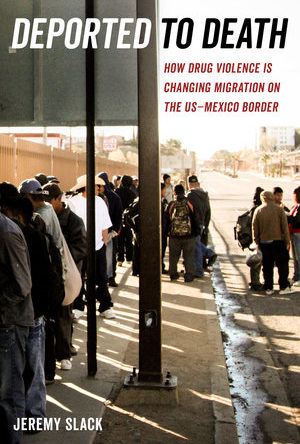
Jeremy Slack, 2019, Deported to Death: How Drug Violence is Changing Migration on the U.S.-Mexico Border. Oakland: University of California Press, 256 pp., ISBN 978-0520297333
The militarization of the U.S. border over the past thirty years coincides with an escalation of “security” measures undertaken by governments to deny people the basic human right to freedom of movement while at the same time affording propertied elites the opportunity to claim land and resources for their own benefit.
U.S. government attempts to control mobility is today undertaken through the deployment of aggressive border patrols and exclusionary policy, the building of walls, the use of high-tech surveillance and, ultimately, the threat of violence. For those on the “other side of the fence,” intimidation, bureaucratization, criminalization, and punishment lay at the core of contemporary immigration practice.
As Jeremy Slack’s Deported to Death makes abundantly clear, undocumented migrants unfortunate enough to be caught by U.S. immigration and deported to Mexico often fall victim to predatory officials and criminal groups. Many individuals are kidnapped, pressed into service for drug cartels, tortured and left for dead. Thus, when the Obama administration deported an unprecedented 3 million persons between 2008 and 2016, countless disappearances and deaths resulted. This same inhumane practice has continued more recently during both the Trump and Biden administrations.
Slack’s penetrating ethnographic study focuses on deportees and the way the “repressive, anti-immigrant [U.S.] machine” has “forcibly returned [these people] in chains” to often unfamiliar places. Such uprooted individuals, he writes, are then “uniquely exposed to violence” as recent U.S. immigration policy has left thousands outcast in dangerous environments with “no one will speak for them, no one [to] look for them,” no one to tell their story (20).
Situated at various sites along the U.S.-Mexico divide, Slack sees the development of the U.S. Border Patrol’s Consequence Delivery System (formalized in 2011) as a watershed moment in immigration policy as “the full brunt of the U.S. justice system” was now deployed “to prosecute and punish undocumented immigrants” (13).
In accord with other scholars writing on the realities of deportation policy such as Daniel Kanstroom, Slack affirms the creation of a “parallel judiciary system that does not provide the right to an attorney, does not place the burden of proof on the state, and is almost entirely based on the assumption that deportation—formal removal—is not a punishment” (25).
Rather, these barbaric, state sponsored procedures are “enacted through a labyrinthine, Kafkaesque bureaucracy [that] give[s] the appearance of legitimacy and justice to people on the outside [and] which serves to normalize the severe harm done by removal” (33).
Slack’s work details how “drug trafficking, undocumented migration, and human smuggling interact in the shared clandestine zone of the border” (37). His intrepid research explores how it is that “processes of disappearance, loss, and suffering related to migration [have] become intertwined with the death toll from Mexico’s so-called “drug war” (38).
Slack interrogates the high stakes migrant experience and identifies the profound way in which organized crime now unfortunately plays a leading role in this transnational process. His ethnography details highly restricted mobility for undocumented persons living in the U.S. and the corresponding dark realty by which unfortunate souls are apprehended and then mercilessly deported to often unfamiliar places in Mexico. Frequently alone and vulnerable, these individuals are often preyed upon by organized crime.
Amazingly, some eventually reach their goal—often in solidarity with other kindred spirits. Slack notes here how it is that certain people even manage to free themselves from state authority and try again. Typically, however, those returned to Mexico without support and sufficient social contact soon find themselves in especially difficult circumstances.
Building walls and constantly amplifying border security does not stop migration but only makes the process more perilous. Often to survive, people will continue to move, generally weighing the risks with the possible benefits of a successful journey. Today, a wide array of migrants are drawn to the U.S.-Mexico border, not just from neighboring Mexico, Central America, and the Caribbean, but from all over the world. In the process, countless individuals, families, and groups are terrorized, traumatized, and turned back. Many die.
At the conclusion of this sympathetic and deeply human study, Slack urges us to think differently about deportation now realizing that at the heart of this process is a profoundly violent and deadly reality.
Andrew Grant Wood is the Rutland Professor of History at the University of Tulsa. He was born in Montreal, Canada, and his research focuses on the history of Mexico. Wood has published on a variety of social and cultural topics: urbanization, immigration, grassroots collective action, housing, regional politics, civic ritual and celebration, tourism, film, and popular music. He is author of Agustín Lara: A Cultural Biography (Oxford, 2014) and is editor and contributor to The Business of Leisure: Tourism History in Latin America and the Caribbean (Nebraska U Press, 2021). Wood is currently writing a history of the port of Veracruz, Mexico.
