
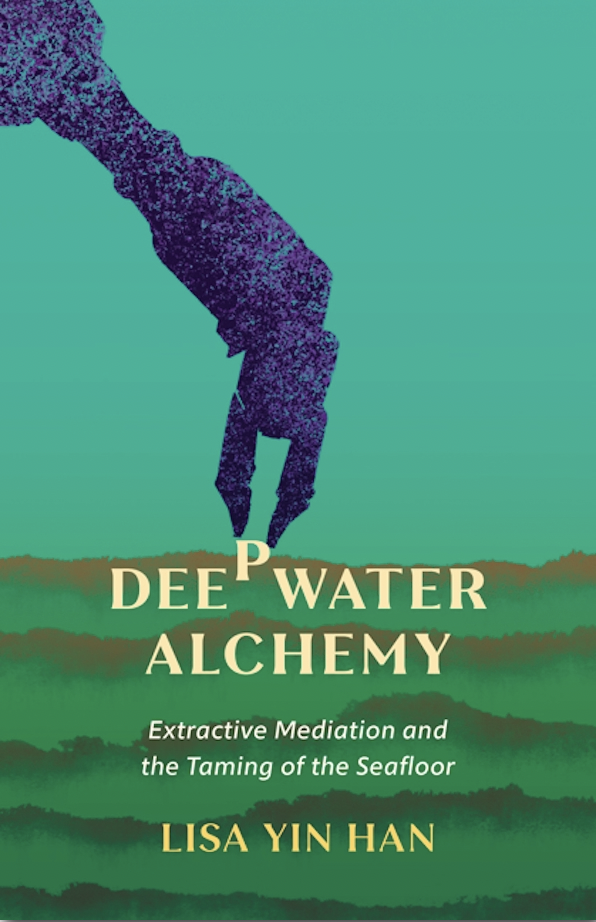
Han, Lisa Yin. 2024. DEEPWATER ALCHEMY. Extractive Mediation and the Taming of the Seafloor. Minneapolis, London: University of Minnesota Press, 256 pp. ISBN: 9781517915940
Despite what its cover might suggest, this is not a book entirely focused on deep-sea mining. However, the timing of the publication of Deepwater Alchemy: Extractive Mediation and the Taming of the Seafloor could not be more appropriate, given the growing global concern about the impending commercialisation of seabed minerals. Nor is this strictly an anthropological book. Instead, it lies at the intersection of environmental studies, media studies and science and technology studies, incorporating decolonial, feminist and multi-species perspectives. Nevertheless, this beautifully written work is sure to become essential reading for anthropologists interested in oceanic extraction, as it provides insight into the cultural representation of the seafloor.
Media scholar Lisa Yin Han explores how the deep sea has historically been, and continues to be, constructed as an extractive frontier, particularly through ocean engineering — the technological apparatus that enables us to imagine the sea as a “speculative replacement of land” (6). This transformation is encapsulated by the book’s central concept of “alchemy,” referring “the material-discursive becoming of the deep ocean, where power is encoded into naturalizations of human technological feats” (4). One of the book’s key arguments is that mediation — the way in which we come to understand the ocean through infrastructures and media technologies — is an extractive process in itself. As she explains, certain forms of media operation (though not all environmental mediations) “participate in nonreciprocal acts of removal, accumulation, and domination” (15), thereby laying the groundwork for extractive industries.
Each of the five chapters that compose the book explores different manifestations of the entanglement between media, digital technologies, and the petroleum and mining industries. As Han argues, a unifying thread across them is the drive for the “removal of information and material from the seafloor to the surface” (21), fueled by a “thirst to know the unknown” (22).
In Chapter One, the author illustrates how the deep seafloor is mediated as both an archive and a frontier — two sides of the same coin. In fact, resource extraction is not limited to natural materials but also includes cultural and epistemological resources. As she argues, “our mediations of the seafloor as an archive of cultural heritage are far from innocent” (28). Han introduces the concept of the “salvage-extraction dynamic” to emphasize that both archaeological expeditions aimed at recovering and making visible what has been lost, and seabed extraction, are ultimately driven by underlying geopolitical agendas and narratives of national identity. She also highlights how, within this linear and static conception of sedimented history, nonhumans have largely been excluded.
Continuing this historical perspective, Chapter 2 examines the extractive mediations of the ocean through the lens of sound technologies used in petroleum exploration, particularly explosives and seismic surveys. Drawing on sound studies and adopting a multi-species perspective on sensing and sounding, Han seeks to make visible and rematerialize what is “taken” in the process of framing noise as interference and signal as meaningful content (61). She shows how seismic surveys offer partial, selective representations of the seabed, effectively “flattening” underwater space and concealing their ecological harm. This analysis also sheds light on how the offshore industry legitimizes its extractive practices — such as drilling and surveying — by framing them as necessary for acquiring knowledge about “how much you have” (75). This raises broader questions about who drives the knowledge-production process. One of the central justifications for deep-sea mining today, for example, is that granting exploration licenses is essential for industry to “discover” what exists at extreme depths — often under the pretense of contributing to science.
In the following chapter, Han turns her attention more directly to deep-sea mining, focusing on the role of sediment plumes — clouds of sediment particles stirred up by extracting operations — in shaping how environmental risk is socially constructed. Through the framework of elemental media theory, Han argues that these plumes are not merely objects of scientific representation, but active participants in the discourse-making of risk. She contends that definitions of underwater hazards are often obscured by terms such as “resilience” (94), echoing concerns raised by geographer John Childs (2019), who critiques how deep-sea mining stakeholders invoke a kind of “nature license to operate” rather than a genuine “social license to operate.” By likening the turbulence caused by mining to naturally occurring underwater phenomena — such as hydrothermal vents or submarine volcanoes — stakeholders strategically downplay the perceived anthropogenic impact (ivi). In this chapter, Han shows how the language of resilience shifts responsibility away from human actors and onto the adaptive capacities of nonhuman life forms. Her analysis poses a critical question: “Is there a temporal limit that marks the boundary between turbulence and catastrophe?” (116). This provocation challenges dominant narratives of sustainability and calls for deeper reflection on the long-term consequences of extractive activities.
Another powerful example of extractive mediation emerges in Chapter 4, in which Han positions whales at the centre of her analysis. She explores how the desire to observe whales has evolved into observing the ocean through them, as telemetry devices transform the animals into mobile oceanographic sensors. Drawing inspiration from Jennifer Gabrys’s Program Earth (2016), Han conceptualizes whales and autonomous underwater sensors as “coworkers in mobile ocean-observing points“ (126), revealing how care and intimacy are increasingly structured by data logics. This transformation situates whale telemetry within a larger global initiative — Oceans 2.0, or the “smart” ocean — framing the ocean as a vast, sensor-laden body akin to “a permanently intubated patient” (150). While Han’s analysis highlights the convergence of scientific and industrial interests in the production of ocean knowledge, it also suggests that these technologically mediated relationships may give rise to “unexpected interspecies intimacies” that transcend instrumental rationality (158).
As Han shows in the final chapter, observatories, as the cabled seafloor pipeline, can “also challenge humanity’s perception of itself in relation to the seas” (187). A compelling example she makes is the phenomenon of “biofouling,” where marine organisms colonize human technologies. Han interprets these entanglements as invitations to imagine alternative human-ocean futurities that move beyond control and efficiency toward the recognition of the deep-ocean as a heterogeneous space.
This book provides a brilliant and timely intervention into contemporary debates around oceanic knowledge production but also on the Blue Economy. It speaks to the growing urgency — shared by scientists, industrial stakeholders, and conservationists — to fill the so-called “knowledge gaps” of the deep ocean. Yet Han’s work challenges the assumption that more data necessarily equates to better stewardship. Instead, she offers a thoughtful deceleration, inviting us to question the cultural, political, and technological assumptions that underpin our engagement with the ocean. Her analysis culminates in a call for ethical ocean mediation, including the imperative to “make space for the unknown” (199). Han reminds us that human relationships with deepwater ecosystems are shaped not only by what we can observe but also by what remains beyond our epistemic reach. What would it mean to resist the urge to collect data?
On a more personal note, what I found missing — particularly from an anthropological standpoint — was a stronger presence of Han’s interlocutors. Their voices are mostly absent, hovering behind the analysis rather than actively shaping it.
Bibliography
Childs, John. 2019. “Greening the blue? Corporate strategies for legitimising deep sea mining”, Political Geography 74, 102060. https://doi.org/10.1016/j.polgeo.2019.102060.
Gabrys, Jennifer. 2016. Program earth: Environmental sensing technology and the making of a computational planet. Minneapolis, MN: University of Minnesota Press.
Author Bio
Marta Gentilucci is a Marie Skłodowska-Curie Postdoctoral Fellow at the Department of Social Anthropology (University of Bergen), where she leads the project OCEAN MINeD on deep-sea mining. She is also the co-founder and co-convenor of the EASA Anthropology of the Seas Network. She has previously conducted ethnographic research in Mayotte on human–environment relations as part of an interdisciplinary project, and in Kanaky–New Caledonia on mining issues for her PhD in Social and Cultural Anthropology, awarded by the University of Milano-Bicocca. She is the author of the monograph La montagna e il capitale. Il cammino kanak del nichel (Prospero, 2022).
© 2025 Marta Gentilucci