
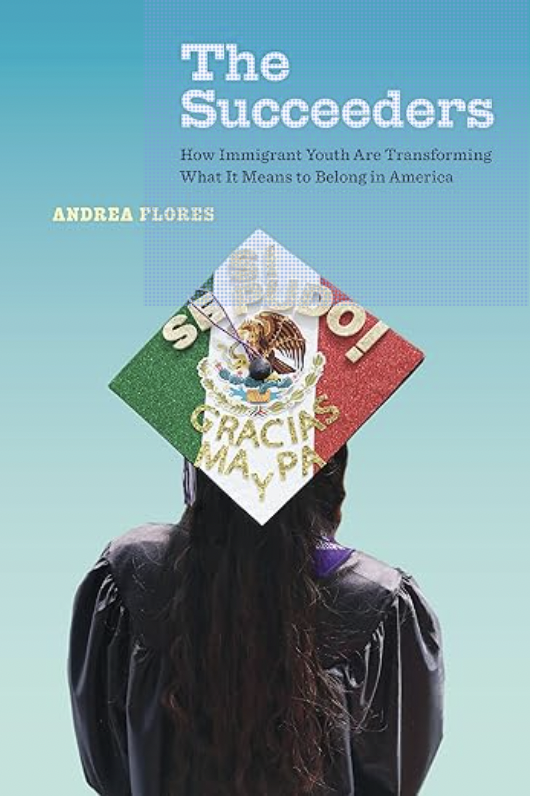
Flores, Andrea. The succeeders: How immigrant youth are transforming what it means to belong in America. Oakland, CA: University of California Press, 2021.
The Succeeders: How Immigrant Youth Are Transforming What It Means to Belong in America is an intriguing and insightful ethnographic study of a program called “The Succeeders,” which supports Latino high school students in Nashville, Tennessee. The author, Andrea Flores who is a white-presenting, half-Latinx American does not directly relate to the students in the Succeeders program, as she came from an upper household where pursuing college was always an option. Instead, she found a deeper connection to the students’ experiences through her mother’s background.
In the ethnography Flores focuses on Latino students’ sense of belonging in high school and the support they receive to pursue higher education. The book is divided into three parts: Context of Belonging, Learning to Belong, and Unlearning to Belong. Flores provides an in-depth exploration of the students’ perspectives on Latinidad stereotypes and how their culture and individual experiences shape their sense of belonging in high school and their pursuit of higher education. She helps us understand that each student has their own definition of success, even if that does not mean the student pursues higher education. This work is important for the field of higher education, as it highlights ways to better support both undocumented and documented Latinidad youth, challenge stereotypes, and foster a greater sense of belonging within academic spaces.
Part One focuses on how students navigate their sense of belonging in both the community and in the Succeeders program. There is a discussion on how the students perceive and define themselves within the framework of the American Dream. Additionally, Flores introduces the students, and how they are welcomed in both the Succeeders program, their community, and their school.
Part Two focuses on Chapter Two and Chapter Three, which have the greatest impact in the book by shedding light on the stereotypes students face. Chapter Two describes a complex version of Duck, Duck, Goose which the students engaged during class. In this activity, a student would stand up, state a word, and see their classmates’ reactions. In one scenario, a student stood up and said the word undocumented. The student’s first reaction to this word was associated with criminality, highlighting how stereotypes contributed to feelings of exclusion at school. Flores explains that some students she interviewed were undocumented and struggled to navigate both school and their communities at home. She also explored how they “understand their membership in the United States” (Flores, 2021, p. 81). As the students reflected on their identities, they began to define culture in their own way, embracing their Latinidad heritage and identity through family and kinship. In the Latinidad community, kinship is strong and plays a significant role in students’ academic success and classroom performance.
This scenario is important for current administrators and faculty in education to understand the impact of stereotypes on Latino students in high school. In addition, these factors influence their hesitation in pursuing higher education. This discussion transitions into Chapter Three, which examines the students’ use of language and how their personal lives and cultural backgrounds influence their pursuit of higher education.
Chapter three strongly resonates with Flores’ argument, as it examines both the students’ culture and how their home lives impact their education. Flores explores the students’ use of language and how they navigate between standard English and what they refer to as ghetto to express themselves. Standard English is used for writing papers and communicating in academic settings, while ghetto is the language they use at home or in more informal conversations. The way and context in which students use these language styles allows them to express themselves authentically. Flores writes, “Your essay is your chance to tell your story. The essay is your ticket into money, into school. Knowing who you are. Your story is your ticket” (Flores, 2021, p. 93). This quote encourages students to share their personal stories in their admission essays, allowing them to express their lived experiences and cultural identities. Encouraging this form of expression brings authenticity to their writing and empowers students to embrace who they are.
This insight is especially valuable for advisors in higher education, as it underscores the importance of supporting students in discovering and affirming their own identities, both inside and outside the classroom. It also encourages advisors to engage with students as individuals rather than make assumptions based on racial or cultural stereotypes, ensuring that each student feels seen, heard, and valued for their unique experience.
Part three covers chapters four, five, and six, along with an exploration of where the students went after graduation. All three chapters focus on kinship and its connection to the students’ success. Flores distinguish relationships between parents, siblings, and friends by highlighting how familial responsibilities impact students’ educational journeys. Understanding the students’ cultural heritage and their connection with family and kinship helps explain why a student may prioritize their siblings or children over their own aspirations. Kinship is a central aspect of Latinidad culture and plays a key role in helping students balance family responsibilities with their schooling. When a student finds friends and a support system, it significantly enhances their sense of belonging and their confidence in achieving graduation and pursuing higher education.
In the Conclusion, Flores discusses the students’ graduation and their paths afterward. While some students pursued higher education, others were unable to do so due to various challenges. These included not only financial limitations but also struggles with inclusion, navigating nativism, and the impact of intergenerational caregiving responsibilities.
Flores talks about one student she engaged with, Emma, who attended college after high school but faced financial struggles while taking eighteen credit hours of classes and working three jobs. Despite these challenges, she graduated college, though it took time to balance her jobs and coursework while succeeding in higher education. Emma formed close friendships with two fellow students from the Succeeders program, who supported her throughout her journey. Her experience highlights the importance of kinship in achieving academic success.
Another student from the Succeeders program, Janitza, graduated from high school but did not pursue higher education. When Flores met with her two years after completing the program, she learned that Janitza had become pregnant during high school. Tragically, her husband “was killed in a random act of violence” (Flores, 2021, p. 193). Due to these hardships, Janitza decided that higher education was not an option for her. However, she redefined success on her own terms, stating that for her, success meant “being a good Latina mother” (Flores, 2021, p. 194).
When Flores revisited the students’ stories, it became evident how much they had grown and embraced their own definitions of success. Success was not dictated by the traditional ideals of the American Dream but rather by what each student viewed as their personal achievements after high school. The students’ individual definitions of success and their post-high school paths highlight the importance of recognizing each student’s unique experience.
Reading and analyzing this ethnography helps both administrators and faculty support younger students in Latinidad communities to pursue higher education while understanding their own definitions of success. It also acknowledges that not all students will be able or want to continue their education and emphasizes the importance of understanding each student’s individual needs and desires for their future.
Katherine Lenkart currently serves as an Enrollment Services Specialist and Immigration Advisor at the International English Center at the University of Colorado in Boulder. She is also pursuing a master’s degree in Higher Education at the University of Colorado Boulder, with a concentration in global education.
© 2025 Katherine Lenkart