
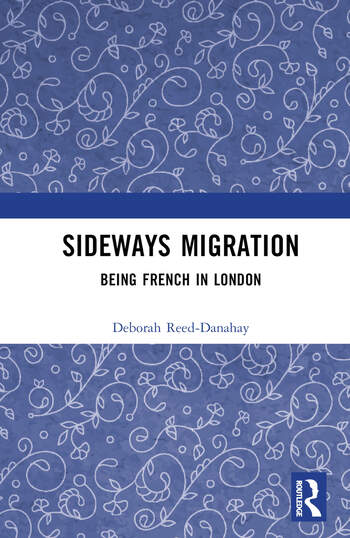
DEBORAH REED-DANAHAY, 2025, Sideways Migration: Being French in London, New York: Routledge, 178 pp. ISBN 978-1-032-73283-1 (hbk), ISBN 978-1- 032-73434-7 (pbk), ISBN 978-1-003-46416-7 (ebk).
KEYWORDS: Sideways migration, the French, London, Brexit, Emplacements and Dislocations
Migration studies is a major well-established area of research with a focus on dangerous escape and precarious conditions in the new country. Yet there are large movements of middle-class lifestyle migrants who relocate to a geographically nearby country similar socially, politically and economically to their country of origin. The French in London are a case in point. In this brilliant book, Deborah Reed-Danahay explores: “The ways in which French citizens experience living in London, as well as the way in which the French are in turn perceived and positioned in London” (p. 19). In order to capture this process, Reed-Danahay introduces the apt concept “sideways migration.” It draws on Ulf Hannerz’ (2006) notion of “studying sideways” which he applied for his study of foreign correspondents. The concept refers to fieldwork where the anthropologist shares status and outlook with interlocutors, this has become quite common.
Reed-Danahay is a leading Bourdieu expert. In Sideways Migration she develops Bourdieu’s ideas by “placing understandings of capital and habitus in the wider contexts of social space” (p.37) and, importantly, shows how French social space reaches beyond the borders of France – to “Paris-on-Thames” – both when it comes to affiliations and practices of French citizens in London and to how institutions, the “French emigration apparatus,” operates. Another explanation to the thoroughness of this well-crafted book is Reed-Danahay’s extensive ethnographic experience of rural migration in France and thus of France. It is a rare advantage when migration scholars are as familiar with the country of origin of the migrants as she is. Reed-Danahay has robust knowledge of French society, culture and politics. It goes without saying that she is a fluent speaker of French. For this study, she has collected personal narratives of relocation to London from France. They illuminate larger structures such as the free movement of EU citizens that was disbanded with Brexit and suddenly turned these rather privileged middle class movers into ordinary migrants that had to submit a cumbersome application to be able to stay in the United Kingdom. This was experienced as humiliating, especially by the aspirational middle classes that perceived “migrants” as poor people they had nothing in common with.
There is no doubt that Reed-Danahay’s appreciation of French culture was key for the success of her research. It unfolded between 2014 and 2024 and included ethnographic fieldwork with participant observation at institutions related to the French population, and social events, during ten visits of altogether 12 months. Since there are few neighborhoods in London where French people typically reside or work or go for entertainment, this is a fieldwork that took place over many sites across the city. Such “several fields in one” (Hannerz 2006; Wulff 2026) is one aspect of urban ethnography. In addition to informal conversations, Reed-Danahay conducted about 60 interviews with French residents. She also included institutional, governmental and business materials for her designation “the emigration apparatus,” as well as some information from digital and print social media such as journalism. Even though most of her interlocutors were more or less middle class, there was a variety in their class background, education and profession, as well as age and length of residence in London. Circumstances of migrating and experiences of settling in London also varied among the interlocutors, which might have something to do with their different places of origin in France: they came from Paris, provincial towns, even overseas French departments. Some interlocutors came from working class and racial minority background and had endured social and economic hardships in London. While most interlocutors were white, a number of them were French citizens of colour. In light of the racial diversity, established since long in London, these French people can thus “pass” for British in looks and dress. They do not appear particularly foreign in the streets of London. That is, until they start speaking. Reed-Danahay’s interlocutors deliberately kept their French accents when they spoke English. This was in line with living in the “French bubble.” Moreover, many found a French accent prestigious. As to gender of the interlocutors, French men were interviewed and included in the study, but the majority were women. A few of them were trailing spouses, but most of the men and women had jobs ranging from teachers, in health care, and with companies, to working for the French government and cultural institutions.
Organized in five chapters, Sideways Migration features a Prologue, an Introduction and a Conclusion. In the Prologue, Reed-Danahay describes La Maison Michelin, an Art-Noveau/Art Deco building in Chelsea which is an iconic landmark of the French in London. For Reed-Danahay it was a fond reminder of her first fieldwork in a rural township close to the city of Clermont-Ferrand, where the Michelin company was based. Thereby the building can be said to connect these two field studies. The Introduction provides a substantial background to the study by explaining both the social and geographical closeness between Paris and London and a history of certain conflict. While “there is a strong theme of ambivalence about France among French people who choose to live outside of its geographic territory (p. 3), there is also the extensive “emigration apparatus” that supports the French migration to London. In the chapter London as a Space of Possibilities, we learn about the cultural importance of “une bonne baguette” and that this is manifest in competitions. Next the chapter on Emplacement and Dislocations shows how both these processes are at stake for the French in London, while the chapter on Fieldwork in “Brexit Time” conveys the drama of this rupture which was unexpected among the French (as among most other Europeans, probably even among those who campaigned and voted for Leave). A chapter on The French Emigration Apparatus details the loose assemblages of the institutions in question. Rather than referring to a migration industry aiming for profit at work only, as Reed-Danahay argues it needs to be understood “alongside governmental agencies, civic associations, and nonprofit organizations” (p. 111) as well as religious and educational institutions and private companies. They all facilitate relocation from France to London. The last chapter brings out French Imaginaries of London Life as depicted in memoirs and fiction. They tend to portray middle class people craving for another possible life, one of emotional and economic security which can come with the French national identity.
Sideways Migration is written in an exemplary lucid style. It is an absorbing account of expectations for (an even) better life. Being French in London used to provide social and economic advancement, it was a sign of prestige – but then came Brexit and much of it fell apart, prompting people who used to feel “J’ai trouvé my place” (p. 51) to return to France. The French population in London was decreasing in the wake of Brexit, but now it is increasing again!
References
Hannerz, Ulf. 2003. “Being there . . . and there . . . and there! Reflections on Multi-Site Ethnography.” Ethnography, 2(4): 229-244. https://doi-org.ezp.sub.su.se/10.1177/14661381030042003
Hannerz, Ulf. 2006. “Studying Down, Up Sideways, Through, Backwards, Forwards, Away and at Home: Reflections on the Field Worries of an Expansive Discipline.” In Locating the Field: Space, Place and Context in Anthropology. Simon Coleman and Peter Collins (eds.), pp. 23-41. Oxford: Berg.
Wulff, Helena. Forthcoming 2026. Diversifying from Within: Migrant Writing in Sweden. London: Routledge.
Helena Wulff is Professor Emerita in the Department of Social Anthropology at Stockholm University. Her research interests are in expressive cultural form – dance, images, text. Key engagements are in the anthropologies of literature and writing. Among her recent publications are the monographs Rhythms of Writing: An Anthropology of Irish Literature (Routledge, 2017) and Diversifying from Within: Migrant Writing in Sweden (Routledge, 2026), the edited volumes The Anthropologist as Writer: Genres and Contexts in the Twenty-First Century (Berghahn, 2016). There is the entry ”Writing Anthropology” (2021) https://www.anthroencyclopedia.com/entry/writing-anthropology. Drawing on her research, she sometimes writes creative essays.
© 2025 Helena Wulff
